
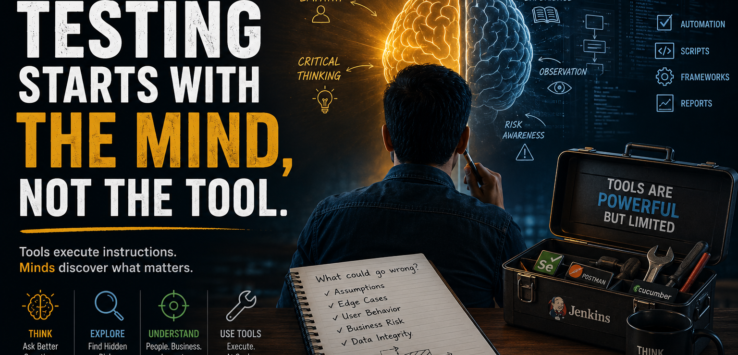
After spending more than fifteen years in software testing, I’ve learned one lesson that no certification, framework, or automation course teaches.
Testing is not about Selenium.
It is not about Playwright.
It is not about Postman.
It is not about AI.
Testing begins much earlier.
It begins inside the tester’s mind.
Unfortunately, many people mistake executing tests for testing software. The two are very different.
A script can execute steps.
A human mind discovers problems.
And that’s why, despite incredible advances in automation and artificial intelligence, great testers remain invaluable.
The Biggest Misconception About Testing
Ask someone what a software tester does, and you’ll often hear:
- Writes test cases
- Executes test cases
- Reports bugs
- Automates regression tests
Those are activities.
They are not testing.
Testing is actually a thinking process.
It starts with questions.
- What could go wrong?
- What assumptions is the developer making?
- What would a frustrated user try?
- What happens if the network disappears?
- What if the data isn’t what we expected?
- What if someone intentionally tries to break this?
Those questions don’t come from a tool.
They come from experience, curiosity, observation, and imagination.
That is the tester’s real superpower.
Every Tool Has a Ceiling
Over the years, I’ve worked with many tools.
Some became popular.
Some disappeared.
But every tool had one thing in common.
They only do what we tell them to do.
A test automation framework never wakes up one morning and says,
“Something feels wrong about this feature. Let me investigate.”
It follows instructions.
If the instructions are incomplete, the automation is incomplete.
If the assumptions are wrong, automation happily confirms the wrong behaviour.
The limitation isn’t the tool.
The limitation is the thinking behind the tool.
Case Study 1 – The Green Automation Suite That Hid a Critical Bug
A project had nearly 2,000 automated test cases.
Every nightly build showed a beautiful green dashboard.
Management was happy.
Developers were happy.
The QA dashboard proudly displayed 100% passed.
Everything looked perfect.
Until customers started complaining.
The application became painfully slow during peak hours.
The automation suite never caught it.
Why?
Because every script validated expected responses.
None of them questioned:
- What happens when 10,000 users login together?
- What if multiple requests hit simultaneously?
- What if memory isn’t released properly?
- What if database locks occur?
The scripts verified functionality.
A tester’s mind would have questioned behaviour.
Two thousand automated tests couldn’t replace one thoughtful question.
Case Study 2 – The Missing Cancel Button
A developer completed a payment workflow.
Automation verified:
✓ Login
✓ Add product
✓ Payment
✓ Success message
Everything passed.
During exploratory testing, I asked myself one simple question.
“What if I change my mind?”
There was no Cancel option.
No Back button.
Closing the browser locked the payment session.
Nobody had thought about the user changing their decision.
The automation wasn’t wrong.
It tested exactly what it was designed to test.
The human mind explored what nobody had designed.
Case Study 3 – Understanding Human Psychology
One healthcare application required patients to enter medical information.
Technically, every field validation worked perfectly.
Automation confirmed all scenarios.
Yet real users frequently abandoned the form.
Watching a few users revealed the problem.
The first screen asked twenty-five mandatory questions.
People became overwhelmed.
They closed the application.
The issue wasn’t validation.
It wasn’t functionality.
It was psychology.
Software isn’t used by robots.
It is used by people.
A good tester doesn’t only understand software.
A good tester understands people.
The Three Minds Every Great Tester Needs
1. The User’s Mind
Users don’t read requirement documents.
They don’t know technical limitations.
They click unexpected buttons.
They refresh pages.
They make mistakes.
Sometimes they simply get distracted.
The best testers constantly ask:
“If I were using this for the first time, what would confuse me?”
Empathy finds bugs.
2. The Developer’s Mind
Developers are intelligent.
But they’re also human.
Humans naturally assume things.
“We’ll never receive null here.”
“This API always returns data.”
“Nobody clicks that twice.”
“Users won’t enter emojis.”
These assumptions become bugs.
A tester should think like a developer—but question every assumption.
3. The Business Mind
Imagine an e-commerce website.
Which bug is more critical?
A typo in the footer?
Or a discount calculation giving every customer 50% off?
Not every bug has equal business impact.
Great testers understand risk.
Quality is about protecting the business, not counting defects.
Why Curiosity Beats Experience
People often ask me,
“How do I become a better tester?”
The answer surprises them.
Not by learning another tool.
By becoming more curious.
Curiosity changes the questions you ask.
Instead of asking,
“Does this work?”
Ask,
- Why does it work?
- Should it work?
- When shouldn’t it work?
- Can someone misuse it?
- Can someone break it?
Curiosity transforms execution into investigation.
When Tools Fail
Every experienced tester has faced moments where tools couldn’t help.
I remember investigating an intermittent production issue.
Automation couldn’t reproduce it.
Logs showed nothing unusual.
Monitoring looked healthy.
Eventually, one observation solved the mystery.
The issue only appeared when users rapidly switched between browser tabs while the session expired in the background.
No automation script had ever simulated that behaviour.
A human did.
Not because of luck.
Because of observation.
Sometimes the smallest human behaviour exposes the biggest defect.
AI Is Powerful. But It Doesn't Own Curiosity.
Today, AI can:
- Generate test cases.
- Write Selenium scripts.
- Produce API requests.
- Suggest edge cases.
- Create test data.
These are incredible capabilities.
I use AI every day.
But AI works from patterns.
Great testing often begins where patterns end.
AI may suggest ten boundary values.
An experienced tester asks,
“What if the business rule itself is wrong?”
That question changes everything.
AI should amplify our thinking.
It should never replace it.
Mind + Tool = Real Quality
This is where many teams make a mistake.
They compare humans against tools.
That comparison is wrong.
A better equation is:
Mind identifies risks.
Tools execute at scale.
Imagine preparing for a marathon.
Your mind decides the route.
Your GPS helps you follow it.
The GPS doesn’t choose your destination.
Testing works the same way.
Your mind decides:
- what deserves testing,
- what deserves automation,
- what deserves investigation,
- and where the real risk lies.
Then the tools help you execute faster.
Without thinking, tools become expensive button-clickers.
Without tools, thinking struggles to scale.
Together, they create quality.
The Mindset I Still Follow After 15 Years
Even after thousands of test cases, hundreds of releases, countless production incidents, and more bugs than I can remember, I still begin every feature with the same questions.
- What assumptions are hiding here?
- What would surprise the developer?
- What would frustrate the customer?
- Where is the highest business risk?
- What isn’t written in the requirement?
- What story is this feature trying to tell?
Because testing has never been about finding bugs.
It has always been about understanding people.
Understanding software.
Understanding risk.
And most importantly…
Understanding how to think.
Final Thoughts
Technology will continue to evolve.
Today’s popular tools will eventually be replaced.
Automation frameworks will change.
AI models will become smarter.
But one thing will remain constant.
The quality of software will always depend on the quality of human thinking behind it.
So before learning the next testing framework…
Train your observation.
Strengthen your curiosity.
Challenge assumptions.
Develop empathy.
Sharpen your mind.
Because the most powerful testing tool you will ever own…
…is the one between your ears.

Leave a Reply