
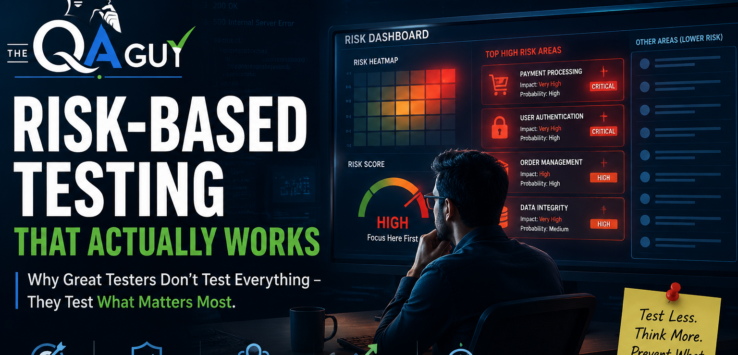
“Testing isn’t about finding every bug. It’s about finding the bugs that matter before your users do.”
One of the biggest misconceptions in software testing is this:
A good tester tests everything.
No.
An experienced tester knows that’s impossible.
After spending more than 15 years in software testing—from startups releasing features overnight to enterprise products with millions of users—I’ve realized one truth:
Testing is not about maximum coverage. It’s about maximum value.
This is exactly where Risk-Based Testing (RBT) comes in.
Unfortunately, many teams claim they practice Risk-Based Testing.
Very few actually do.
Most simply prioritize test cases based on deadlines.
That’s not Risk-Based Testing.
Real Risk-Based Testing is a way of thinking.
And like everything in testing…
It starts with the mind, not the tool.
What is Risk-Based Testing?
Let’s remove all textbook definitions.
Risk-Based Testing simply means this:
Spend your testing effort where failure will hurt the business or the customer the most.
Every application contains thousands of possible scenarios.
No team has unlimited time.
No company has unlimited budget.
No release has unlimited patience.
So the real question becomes:
If something breaks tomorrow…what should absolutely NOT break?
That is where testing begins.
Risk = Probability × Impact
Every experienced tester unknowingly evaluates two questions.
1. How likely is this to fail?
This is Probability.
Factors include:
- New feature
- Complex logic
- Frequent code changes
- Multiple integrations
- New developer
- Refactoring
- Historical defects
2. If it fails…
…how much damage will it cause?
That’s Impact.
Think about:
- Revenue loss
- Customer trust
- Legal issues
- Data corruption
- Security
- Brand image
- Operational downtime
High Probability + High Impact = Highest Testing Priority.
Simple.
But incredibly powerful.
The Biggest Mistake Testers Make
Many testers confuse:
“Important feature”
with
“Risky feature”
These are not the same.
Example:
A Profile Picture Upload feature may be important.
But a Payment Processing feature?
That is risky.
If profile upload fails…
Users get annoyed.
If payment fails…
Customers lose money.
Support gets flooded.
Twitter starts trending.
Executives start calling.
Same application.
Different risk.
Different testing effort.
Real Scenario #1 — E-Commerce Checkout
Imagine you’re testing an online shopping application.
There are these modules:
- Homepage
- Product Search
- Wishlist
- Reviews
- Coupons
- Checkout
- Payment
- Order Confirmation
You have only one day before release.
Can you test everything?
Impossible.
A beginner says:
“Let’s execute all regression cases.”
An experienced tester says:
“Where can we lose money?”
Immediately the focus shifts to:
- Cart calculation
- Discounts
- Coupon combinations
- Taxes
- Payment gateway
- Order creation
- Inventory deduction
- Confirmation email
Notice something?
Nobody started with Homepage Banner Testing.
Because business risk is different.
Real Scenario #2 — Banking Application
Suppose your bank launches a new feature:
“Change Mobile Number.”
Seems simple.
Should we spend much time?
Maybe not.
Now compare it with:
“Fund Transfer.”
Imagine a defect:
₹50,000 is deducted.
Recipient never receives money.
How expensive is this bug?
Not just financially.
Think about:
- Customer panic
- Banking complaints
- RBI escalations
- Reputation damage
- Media coverage
One missed defect.
Millions lost.
This deserves:
- Positive testing
- Negative testing
- Boundary testing
- API validation
- Database verification
- Retry scenarios
- Network interruption testing
- Duplicate submission testing
- Performance testing
Risk decides effort.
Not feature size.
Real Scenario #3 — Hospital Management System
A hospital application contains:
- Appointment booking
- Doctor profile
- Patient records
- Billing
- Medicine inventory
A UI alignment issue appears.
Low risk.
A spelling mistake appears.
Low risk.
Now imagine this defect.
Patient A’s laboratory report is shown to Patient B.
Everything changes.
Now we’re dealing with:
- Privacy violation
- Legal consequences
- Wrong treatment
- Patient safety
Suddenly,
Testing becomes more than software.
It becomes responsibility.
Real Scenario #4 — Food Delivery Application
Suppose a restaurant receives duplicate orders because users pressed “Place Order” twice during slow internet.
Developers may say:
“We already disabled the button.”
Experienced testers ask:
“What if JavaScript fails?”
“What if the request times out?”
“What if users refresh?”
“What if mobile internet reconnects?”
“What if payment succeeds but order creation fails?”
One thoughtful tester can uncover ten scenarios that no automation script will naturally imagine.
That’s risk thinking.
Real Scenario #5 — Airline Booking
A family books four tickets.
Payment succeeds.
Only two seats get confirmed.
Remaining amount is deducted.
Think about the chaos.
Airport staff.
Refunds.
Support tickets.
Social media complaints.
Vacation ruined.
Again…
High impact.
Needs deeper testing.
Risk Isn’t Always Technical
One mistake many testers make is assuming risk only comes from code complexity.
Actually, risk comes from people too.
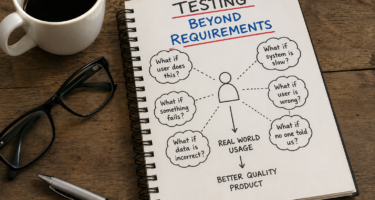
User Behaviour
Users never follow requirements.
They:
- Click Back repeatedly.
- Open multiple tabs.
- Refresh continuously.
- Leave sessions idle.
- Use slow internet.
- Switch devices.
- Enter unexpected values.
- Cancel midway.
Real users create real risks.
Great testers understand human psychology.
Developer Behaviour
Developers also introduce predictable risks.
Some examples:
“We changed only one line.”
Those are often the most dangerous changes.
“We only optimized performance.”
Optimization frequently changes logic unintentionally.
“This API is untouched.”
Maybe.
But another API consuming it changed.
Understanding developer behaviour helps predict hidden defects.
Business Behaviour
Sometimes risk changes overnight.
Example:
Yesterday:
Coupon feature wasn’t important.
Today:
Marketing launches
“70% OFF Flash Sale”
Now that coupon engine handles millions of transactions.
Same code.
Different business risk.
Risk changes with business context.
Risk-Based Testing During Regression
Many teams execute 3,000 regression cases before every release.
Ask yourself:
How many actually protect the business?
Often,
Hundreds of low-value tests run for hours.
Meanwhile,
Critical integrations receive only five minutes of attention.
That’s backwards.
A better approach:
Tier 1 (Highest Risk)
Always execute.
Examples:
- Login
- Payments
- Orders
- Authentication
- Data integrity
Tier 2 (Medium Risk)
Execute depending on changes.
Tier 3 (Low Risk)
Run when time permits or automate.
Now testing becomes intelligent.
Not mechanical.
The Human Side of Risk
Risk isn’t just about software.
It’s about emotion.
Imagine:
A mother ordering medicine online.
A patient booking emergency appointments.
A student submitting university applications.
A businessman transferring salaries.
Every feature affects someone’s day.
Maybe someone’s month.
Sometimes someone’s life.
Risk-Based Testing reminds us:
We don’t test software.
We protect people from software failures.
Questions Experienced Testers Ask Before Testing
Instead of asking:
“What should I test?”
Ask:
- What can fail?
- Why can it fail?
- Who suffers if it fails?
- How often will users use it?
- What happens if this breaks at midnight?
- Can money be lost?
- Can data be corrupted?
- Can trust be broken?
These questions naturally reveal priorities.
Automation Doesn’t Replace Risk Thinking
Automation executes.
Humans prioritize.
You can automate 10,000 tests.
Yet miss the one scenario that costs the company ₹10 crore.
Because automation doesn’t decide importance.
People do.
This is why experienced testers remain valuable even in an AI-driven world.
AI can generate tests.
Tools can execute them.
Only thoughtful testers understand business risk.
How to Practice Risk-Based Testing Every Day
Here’s a simple habit that transformed the way I test.
Before writing even a single test case, answer these five questions:
| Question | Why It Matters |
|---|---|
| What is changing? | New code brings uncertainty. |
| Who uses it the most? | Frequently used features deserve more attention. |
| What happens if it fails? | Measures business impact. |
| Has it failed before? | History often repeats itself. |
| Which integration depends on it? | Hidden dependencies are common sources of defects. |
These five questions often reveal more than a hundred test cases.
Final Thoughts
Testing every feature equally may feel fair.
But software doesn’t fail equally.
Neither do businesses.
Risk-Based Testing isn’t a document.
It isn’t a checklist.
It isn’t a testing technique reserved for large enterprises.
It is a mindset.
A way of seeing software through the eyes of customers, developers, businesses, and reality.
The best testers I’ve worked with weren’t the ones who executed the most test cases.
They were the ones who could walk into a sprint planning meeting, look at a feature for five minutes, and quietly say:
“If this part fails, we’ll have a serious problem.”
More often than not…
They were right.
And that’s what experience teaches you.
Not how to test more.
But how to test what truly matters.
Closing Thought
“Risk-Based Testing isn’t about reducing testing. It’s about increasing the value of every minute you spend testing. Great testers don’t chase every bug—they chase the bugs that could change someone’s day, damage a business, or break a customer’s trust.”
Because in the end,
Quality isn’t measured by the number of test cases executed.
It’s measured by the failures your users never experience.

Leave a Reply