
Stop Writing Test Scripts. Start Building a System.
After spending more than 15 years in software testing, I’ve realized one thing: automation frameworks don’t fail because of bad code. They fail because of bad thinking.
Many teams spend months building an automation framework. It looks impressive. It generates beautiful reports. It runs hundreds of test cases. But after a year, no one wants to touch it. Every small change breaks ten other tests. New team members are afraid to contribute. Eventually, the framework becomes another legacy application.
A scalable automation framework is not just a collection of Selenium scripts. It is a software product built for testers.
Let’s see how experienced automation engineers think.
Chapter 1: Build for the Next Engineer, Not for Yourself
One mistake I see very often is building a framework around today’s project instead of tomorrow’s requirements.
Before writing your first line of code, ask yourself:
- Can a new tester understand this framework in one day?
- Can it support Web, API, Database and Mobile testing?
- Can multiple testers work together without conflicts?
- Can I replace Selenium with Playwright later without rewriting everything?
If the answer is “No”, your framework is already becoming technical debt.
Case Study
In one enterprise project, we had nearly 4,000 automated test cases. The original automation engineer had written everything inside one utility class because “it was faster.”
When he left the company, nobody understood the framework.
Simple bug fixes started taking days instead of hours.
Finally, the team rebuilt the framework from scratch.
The lesson?
Build a framework that can survive people leaving the team.
Chapter 2: A Good Framework Has a Place for Everything
Think of your framework like a well-organized house. Everything should have its own place.
AutomationFramework/

│── config/
│── testdata/
│── pages/
│── api/
│── drivers/
│── utilities/
│── reports/
│── logs/
│── screenshots/
│── execution/
│── database/
│── tests/
│── resources/
Every folder exists for one reason.
config/
Stores environment URLs, browser settings, credentials and application configuration.
Never hardcode these values.
pages/
Contains Page Objects.
Each page knows only about its own elements and actions.
class LoginPage:

    def login(username, password):
        enter_username(username)
        enter_password(password)
        click_login()
Business logic should never be mixed with page locators.
testdata/
Keep all test data outside your code.
login.json

users.xlsx

orders.csv
Changing test data should never require changing code.
utilities/
Reusable helper methods.
Examples:
- Excel Reader
- JSON Parser
- Screenshot Utility
- Date Generator
- Random Test Data
If you copy the same code twice, move it into Utilities.
reports/
Store execution reports.
Good reports answer:
- What failed?
- Why did it fail?
- Screenshot?
- Stack trace?
- Environment?
- Browser?
Managers love pass percentages.
Engineers love useful failure details.
Build reports for engineers.
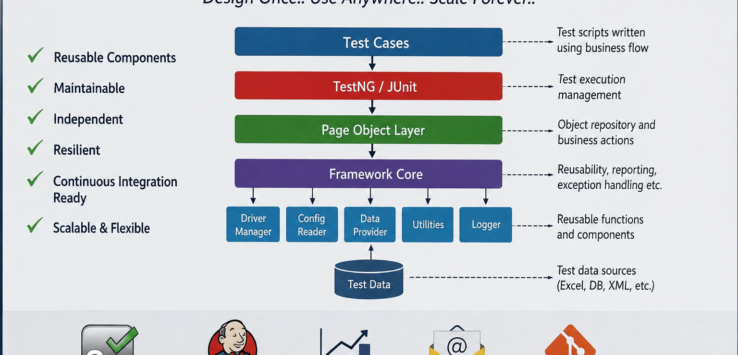
Framework Architecture
A scalable framework follows a simple flow.
            Test Cases
                 │
                 ▼
          Test Runner
                 │
                 ▼
      Configuration Manager
                 │
                 ▼
          Driver Manager
                 │
                 ▼
     Page Objects / API Layer
                 │
                 ▼
      Utilities & Libraries
                 │
                 ▼
      Reports + Logs + Screenshots
Notice something.
Every layer has one responsibility.
That is exactly how scalable software is built.
Design Patterns That Actually Help
Many engineers use design patterns because interview questions ask about them.
Use them only when they solve a real problem.
Page Object Model
Keeps UI actions separate from test cases.
Test

↓

LoginPage

↓

Browser
Cleaner tests.
Easy maintenance.
Factory Pattern
Creates browser drivers.
Chrome

Firefox

Edge
Instead of writing browser code everywhere, let one class decide.
Singleton Pattern
Useful for Configuration Manager.
Read configuration once.
Use it everywhere.
Chapter 3: Think Beyond Test Execution
Many frameworks stop after generating an HTML report.
Enterprise frameworks go much further.
Every execution should answer questions like:
Execution ID

Build Number

Git Branch

Browser

Environment

Execution Time

Failed Step

Screenshot

Logs

API Response

Database Validation
This information saves hours during debugging.
A test that simply says
Login Failedis useless.
Instead write
Execution : REG_245

Environment : SIT

Browser : Chrome 137

Expected : Dashboard displayed

Actual : HTTP 500 received

Screenshot : Attached

API Response : Logged

Execution Time : 12 sec
That is a report developers can actually use.
Real Project Example
Our regression suite had nearly 2,000 test cases.
Initially, failures took almost three hours to investigate every morning.
We introduced:
- Better logging
- Screenshots
- API request logging
- Database validation
- Execution IDs
Investigation time dropped to less than 30 minutes.
We didn’t improve testing.
We improved information.
Chapter 4: Your Framework Reflects Your Thinking
I’ve seen teams spend weeks arguing about Selenium versus Playwright.
Honestly, that is the wrong discussion.
Framework quality has very little to do with the automation tool.
A poorly designed Playwright framework will fail just like a poorly designed Selenium framework.
Technology changes.
Architecture stays.
Good automation engineers don’t chase tools.
They build systems that can adapt.
Final Advice from 15 Years in QA
- Keep every class small.
- Never duplicate code.
- Name everything clearly.
- Separate data from logic.
- Log everything that helps debugging.
- Write automation for the next engineer, not for yourself.
- Review your framework like production code.
- Remember that maintenance costs more than development.
At the end of the day, an automation framework is not measured by how many test cases it executes.
It is measured by how confidently a team can maintain it after five years.
That’s what makes a framework truly scalable.


Leave a Reply