
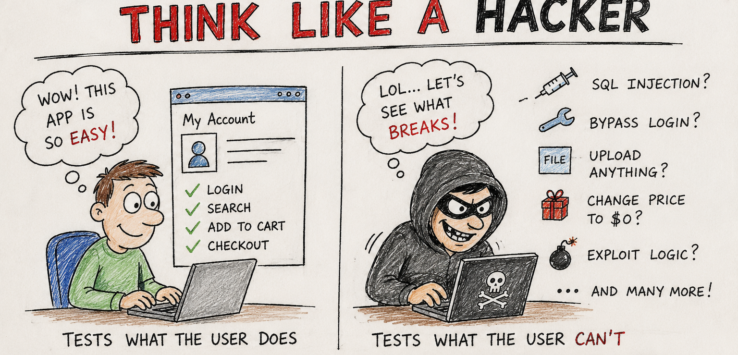
“Users show you how software is used. Hackers show you how software is abused. Great testers understand both.”
One lesson I’ve learned after 13 years in software testing is this:
If you only test like a user, you’ll miss security and misuse issues.
If you only think like a hacker, you’ll forget what real customers actually care about.
The best testers do both.
They use the application like a customer…
but they also question every assumption like someone trying to break it.
That’s where real quality begins.
Scenario 1: The Login Screen
A normal user opens the login page.
They enter:
- Correct username
- Correct password
Login successful.
Everything looks good.
Now switch your mindset.
Think like a hacker.
What if someone enters:
- SQL commands instead of a username?
- 5,000 characters in the password field?
- HTML or JavaScript?
- Hundreds of login attempts within a minute?
Suddenly, you’re testing a completely different application.
The screen hasn’t changed.
Your mindset has.
Scenario 2: The Discount Coupon
An e-commerce website allows users to apply a coupon.
A user simply enters:
SAVE20
Discount applied.
Looks perfect.
Now think differently.
What if I:
- Apply the same coupon 20 times?
- Use an expired coupon?
- Edit the API request and change the discount from 20% to 90%?
- Apply two coupons together even though only one is allowed?
A customer follows the rules.
A hacker checks whether the rules actually exist.
Scenario 3: The File Upload Feature
The requirement says:
“Users can upload profile pictures.”
As a normal user, you upload:
- JPG
- PNG
Everything works.
Now become curious.
What if I upload:
- A PDF?
- A ZIP file?
- A renamed executable file?
- A 200 MB image?
- A file with special characters in its name?
Many production issues are found simply because someone asked,
“What if the user doesn’t do what we expect?”
Developers Build. Users Explore. Hackers Exploit.
Developers usually build software assuming people will use it correctly.
Users don’t always do that.
Hackers definitely don’t.
As testers, our responsibility is to bridge that gap.
We don’t just verify functionality.
We verify behaviour under unexpected conditions.
A Small Habit That Changes Everything
Whenever you’re about to test a feature, ask yourself these two questions.
Question 1
“If I were the customer, what would I naturally do?”
This helps you test usability, workflows and user experience.
Question 2
“If I wanted to break this feature, what would I try?”
This helps uncover hidden defects, security gaps and missing validations.
Just these two questions can completely change the way you test.
Thinking Like a Hacker Doesn’t Mean Hacking
Many testers hesitate when they hear the word hacker.
You don’t need to be a cybersecurity expert.
Thinking like a hacker simply means:
- Don’t trust user input.
- Don’t assume people follow instructions.
- Try unexpected combinations.
- Challenge every validation.
- Ask “What if?”
Curiosity is more important than hacking knowledge.
Key Takeaways
A mindful tester doesn’t stop after seeing the expected result.
They keep asking:
- What if the user makes a mistake?
- What if the internet is slow?
- What if someone misuses this feature?
- What assumptions are we making?
- What could go wrong in production?
Those questions often find bugs that automation and requirement documents never will.
Final Thoughts
Testing isn’t only about confirming that software works.
It’s about discovering how it can fail.
A user teaches you how the product is meant to be used.
A hacker teaches you how it could be broken.
A mindful tester learns from both.
Because in the real world…
Users create experiences.
Hackers expose weaknesses.
Great testers understand both.
Test like a User. Think like a Hacker. Deliver quality like a Tester.



Leave a Reply