
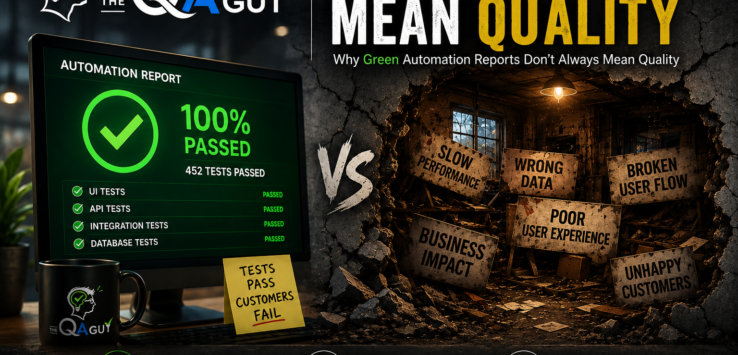
"Automation tells you that your scripts passed. It doesn't tell you whether your customers are happy."
Every morning, thousands of QA teams open their dashboards.
412 Tests Passed.
0 Failed.
Build Successful.
100% Green.
The Slack channel celebrates.
The CI/CD pipeline moves forward.
The release is approved.
A few hours later…
- Customers complain they cannot place orders.
- Payments are getting declined.
- Search results are wrong.
- The mobile app feels painfully slow.
- Support tickets start increasing.
The first question everyone asks is:
“But automation was green… how did this happen?”
After spending more than 15 years testing enterprise applications, banking systems, healthcare products, e-commerce platforms, and internal business applications, I’ve seen this story repeat itself countless times.
The biggest misconception in software testing today is believing that a green automation report is proof of software quality.
It isn’t.
A green report simply proves one thing:
The automation scripts observed exactly what they were programmed to observe.
Nothing more.
Quality lives far beyond automated assertions.
Automation Measures Execution. Testing Measures Understanding.
Automation is exceptional at checking predefined expectations.
Examples:
- Login succeeds
- API returns HTTP 200
- Button is clickable
- Database row exists
- Email gets triggered
- Response matches expected JSON
These are valuable.
But software quality also depends on questions that no automation script naturally asks.
Questions like:
- Does this make sense to a customer?
- Is the workflow confusing?
- Will users trust this screen?
- Is the response meaningful?
- Is performance acceptable?
- Is the business logic still correct?
- Can people recover after making mistakes?
Automation verifies.
Testing investigates.
There is a huge difference.
The Psychology Behind Green Reports
Green reports make everyone comfortable.
Managers see progress.
Developers gain confidence.
Product owners assume stability.
Even testers start believing everything is fine.
Why?
Because humans naturally trust measurable numbers.
100% Passed.
2500 Automated Tests.
98% Coverage.
They look scientific.
But numbers only represent what was measured.
Imagine checking your body temperature every hour.
Temperature is normal.
Does that prove you’re perfectly healthy?
No.
You could still have:
- high blood pressure
- anxiety
- vitamin deficiencies
- internal injuries
The thermometer wasn’t designed to detect those.
Automation is your thermometer.
Testing is your doctor’s diagnosis.
Automation Doesn’t Think Like Humans
Users rarely behave the way automation scripts do.
Automation behaves perfectly.
Humans don’t.
Automation:
- enters valid data
- follows expected flow
- clicks correct buttons
- waits patiently
- never gets distracted
- never changes their mind
Real users:
- type incorrect emails
- double-click buttons
- refresh pages repeatedly
- switch between browser tabs
- lose internet connection
- paste unexpected characters
- abandon carts midway
- come back after several days
Real software is built for humans.
Not scripts.
Case Study: The Green Release That Lost Thousands of Orders
A large retail company had invested heavily in automation.
Every release included:
- 3,500 UI tests
- 1,800 API tests
- hundreds of database validations
Release day arrived.
Everything was green.
Management approved deployment immediately.
Within three hours, customer support was flooded.
Customers were adding products to the cart.
But many abandoned checkout.
Initially everyone suspected payment gateway issues.
Nothing was wrong.
Eventually a tester manually reproduced the issue.
The checkout page loaded perfectly.
Buttons worked.
Payment succeeded.
Automation had validated all of this.
The actual problem?
A promotional coupon textbox had moved below the payment section after a UI redesign.
Regular customers always applied coupons before paying.
Unable to find the coupon field, many assumed coupons were removed.
Thousands abandoned their purchases.
Nothing had technically failed.
The business had.
Automation verified functionality.
Only human observation could identify the broken customer experience.
That single UI change cost the company several crores in lost sales before it was fixed.
No automation report could have predicted that.
Real-World Scenarios Where Green Reports Failed
1. Search Results Were Technically Correct
Automation checked:
- Search API returned HTTP 200
- Products displayed
- Pagination worked
Users searched:
“Wireless Mouse”
The first results were:
- Mouse Pad
- Keyboard
- USB Cable
The search engine worked.
Customers still couldn’t find what they wanted.
Business quality failed.
2. Login Worked... But Took 18 Seconds
Automation assertion:
Login SuccessfulGreen.
Real users:
“Why is this app so slow?”
Nobody cares if login succeeds after 18 seconds.
Users leave long before that.
3. Payment Completed Twice
Automation clicked the Pay button once.
Everything passed.
Real customers with slow internet clicked Pay multiple times.
Duplicate orders.
Duplicate payments.
Refund requests.
Automation never simulated impatient humans.
4. Responsive Design Passed
Automation verified elements existed.
On smaller phones:
- text overlapped
- buttons disappeared below the screen
- important labels were cut
Technically everything rendered.
Practically it became unusable.
5. Notification Was Sent
Automation checked:
Email generated.
Pass.
Users received:
“Dear Customer,”
Blank content.
Missing order information.
Wrong formatting.
Emails technically existed.
Communication failed.
6. API Returned Correct Response
API:
200 OKAutomation passed.
Business logic changed last week.
Discount calculations were incorrect.
Every order had wrong pricing.
Technically healthy.
Financially disastrous.
7. User Could Upload Files
Automation uploaded:
sample.pdfUsers uploaded:
Invoice_Final(Version 7).pdfSystem failed because of special characters.
Automation never tried realistic filenames.
8. Everything Worked Individually
Automation:
Login ✔
Search ✔
Checkout ✔
Logout ✔
Users:
Login
Search
Wishlist
Back
Compare
Remove Item
Apply Coupon
Change Address
Refresh
Checkout
One tiny state management issue caused the order to disappear.
Real workflows are rarely linear.
9. Accessibility Was Never Considered
Automation confirmed buttons existed.
Screen reader users couldn’t identify them.
Keyboard navigation broke.
Contrast was poor.
Thousands of users struggled.
Automation never complained.
10. Error Message Passed Validation
Automation checked:
Error Message DisplayedUsers saw:
Unexpected Error Code : XA-1089-775Technically correct.
Completely meaningless.
Good software explains.
Not just reports.
The Most Dangerous Sentence in QA
"Automation passed, so we skipped manual testing."
I’ve heard above sentence countless times.
This usually means:
“We skipped thinking.”
Automation should remove repetitive work.
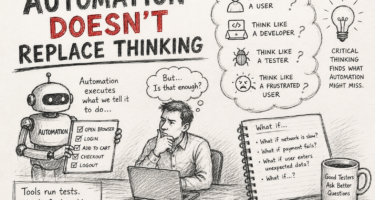
It should never replace curiosity.
What Mindful Testers Do Differently
Experienced testers don’t stop when automation turns green.
Instead they ask:
- What assumptions did automation make?
- What user behavior wasn’t simulated?
- What business risks still exist?
- What would confuse first-time users?
- What happens when the network is unstable?
- What if users perform unexpected actions?
- What if data isn’t perfect?
- What if business rules changed?
These questions uncover defects that no framework can discover by itself.
Green Doesn’t Mean Good
Imagine buying a car.
The manufacturer tells you:
- Engine started successfully ✔
- Doors opened ✔
- Wheels rotated ✔
Would you immediately drive it across the country?
Probably not.
You’d still check:
- Does it brake properly?
- Is it comfortable?
- Does the steering feel right?
- Is it safe?
- Can your family trust it?
Software deserves the same thinking.
Final Thoughts
Automation has transformed software testing, and every modern QA team should embrace it.
But we must also remember its boundaries.
Automation is incredibly good at answering questions we already know to ask.
Testing is about discovering the questions nobody thought to ask.
That’s where experience matters.
That’s where curiosity matters.
That’s where mindfulness matters.
A green dashboard should give you confidence—not certainty.
Because software quality is never measured only by passing scripts.
It is measured by the confidence your users feel every time they interact with your product.
So the next time someone proudly says,
“Everything is green.”
Pause for a moment and ask one simple question:
“Green according to whom?”
Because your automation reports don’t release software.
Your users do.
The QA Guy's Takeaway
Automation verifies expectations.
- Mindful testing challenges assumptions.
2. Quality begins where automation ends.
3. Because testing doesn’t start with Selenium, Playwright, Cypress, or AI.
4. Testing starts with the mind, not the tool.

Leave a Reply