
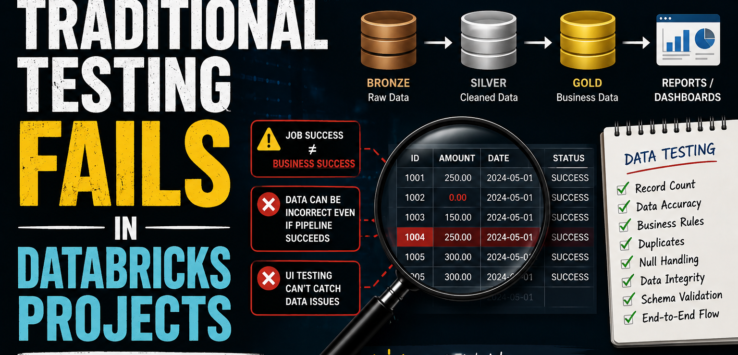
If You’re Testing Databricks Like a Web Application, You’re Already Missing Bugs.
A few months ago, a junior QA engineer asked me,
“How do I test a Databricks project? There is no UI.”
I replied,
“Good. Now you can start doing real testing.”
He looked confused.
After spending over 15 years in testing, I’ve noticed something interesting.
Many experienced UI testers struggle when they move to Databricks or Data Engineering projects.
Not because Databricks is difficult.
But because they continue using a traditional testing mindset.
And that’s where things go wrong.
“Where Are the Test Cases?”
In a normal application, you test screens.
- Login
- Dashboard
- Search
- Checkout
Simple.
But in Databricks…
There may not be a single screen.
Instead, data travels through multiple stages.
Source File

↓

Bronze Layer

↓

Silver Layer

↓

Gold Layer

↓

Reports / APIs / Dashboards
Your customer never sees these layers.
But one small mistake here can affect millions of records.
That’s why data testing requires a completely different way of thinking.
Case Study 1 – Everything Passed… Except the Business
One project processed nearly 25 million transactions every night.
The ETL pipeline completed successfully.
Notebook execution passed.
No exceptions.
Job Status?
✅ Success
Everyone celebrated.
The next morning, the finance team reported missing transactions.
What happened?
The transformation logic accidentally filtered records where
Amount = 0Those records represented free promotional transactions.
Technically…
The pipeline worked.
Business-wise…
It failed.
Databricks doesn’t care if your notebook finishes.
Business users care whether the data is correct.
In Databricks, Data Is Your User Interface
When testing web applications, we verify buttons and labels.
When testing Databricks, we verify data.
Ask questions like:
- Are records missing?
- Are duplicate records created?
- Is every column transformed correctly?
- Are NULL values handled?
- Is the schema changing unexpectedly?
- Are timestamps converted correctly?
- Is data reaching the correct layer?
Your eyes should be on the data, not just the notebook execution.
Case Study 2 – The Time Zone Disaster
A global company stored timestamps in UTC.
A new Databricks transformation converted everything to local time.
Notebook executed successfully.
All unit tests passed.
A week later…
Reports in India showed different sales numbers than reports in London.
Nothing was technically broken.
The timestamps were.
A two-hour difference changed daily business reports.
The issue wasn’t coding.
It was understanding the business.
Don’t Just Count Records
Many testers validate only this.
Source Records = 1,000,000

Target Records = 1,000,000

PASS
That tells you almost nothing.
Instead ask,
- Did every customer’s balance remain correct?
- Were calculations accurate?
- Were duplicates removed?
- Were invalid records rejected?
- Was sensitive data masked?
- Did partitioning work correctly?
Two tables can have the same record count and still contain completely wrong data.
Case Study 3 – The Duplicate Customer
A customer should appear only once.
Simple business rule.
A Spark job accidentally joined two datasets incorrectly.
Result?
Customer A

↓

Customer A

↓

Customer A
Three identical records.
Record count looked fine.
Pipeline passed.
Notebook passed.
The dashboard showed triple revenue.
The CEO loved the numbers.
Until Finance investigated.
One incorrect JOIN created a million-dollar reporting mistake.
Think Like a Data Detective
When I mentor junior QA engineers, I tell them,
Don’t ask,
“Did the notebook run?”
Ask,
- Where did the data come from?
- Where is it going?
- What changed?
- What should never change?
- What happens if today’s source file is empty?
- What if new columns are added?
- What if duplicate records arrive?
- What if data arrives late?
That’s how experienced data testers think.
Traditional Testing vs Databricks Testing
| Traditional Testing | Databricks Testing |
|---|---|
| Test screens | Test data |
| Validate UI | Validate transformations |
| Verify buttons | Verify business rules |
| Check workflows | Check data pipelines |
| User actions | Data movement |
| Visual validation | SQL and data validation |
You’re no longer testing an application.
You’re testing the truth hidden inside the data.
Final Thoughts
One of the biggest mindset shifts in Databricks testing is this:
A successful job doesn’t always mean successful data.
Your notebook can finish in five minutes.
Spark can report zero errors.
The pipeline can turn green.
And the business can still lose millions because one transformation was wrong.
As testers, our responsibility isn’t to verify that code executed.
Our responsibility is to verify that the business received the right data.
Because in Databricks projects…
Data is the product.
And the best testers don’t just test pipelines.
They protect the decisions that businesses make from that data.

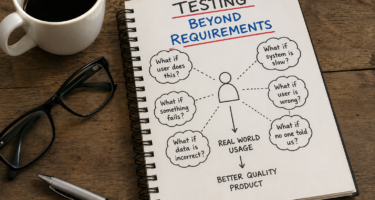

Leave a Reply