
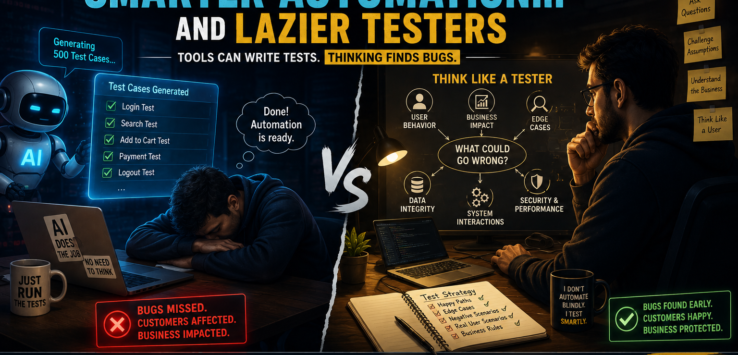
The Biggest Risk in Software Testing Today Isn’t AI. It’s Testers Who Have Stopped Thinking.
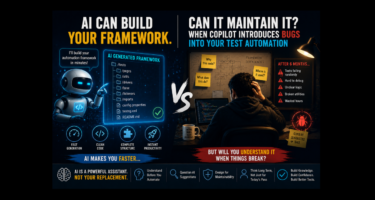
A few months ago, I reviewed an automation framework written almost entirely with AI.
The code looked beautiful.
Clean structure.
Perfect naming.
Excellent comments.
Almost no syntax issues.
I thought,
“This is impressive.”
Then I asked one simple question.
“Why are you validating this field?”
The engineer looked at me for a few seconds and finally admitted,
“Honestly… AI generated it. I didn’t think about it.”
That answer scared me.
Not because AI wrote the code.
But because the tester stopped thinking.
After spending more than 15 years in software testing, I’ve learned one truth:
A bad tester with AI becomes faster.
A good tester with AI becomes unstoppable.
The difference is thinking.
AI Is Becoming the Brain… and That’s Dangerous
Today AI can generate almost everything.
- Test cases
- Automation scripts
- API validations
- SQL queries
- Page Objects
- Frameworks
- Bug descriptions
That’s amazing.
But slowly, something dangerous is happening.
Many testers no longer ask,
“Is this correct?”
Instead they ask,
“Did AI generate it?”
That’s a huge difference.
Case Study 1 – 500 Test Cases… Zero Thinking
One project needed regression testing.
A QA engineer asked AI to generate test cases.
Within minutes…
500 test cases.
Management was impressed.
The document looked professional.
A week later, production failed.
Why?
Nobody tested this simple scenario.
Customer loses internet while payment is processing.
AI didn’t include it.
The tester never questioned it.
The bug cost thousands of dollars in duplicate transactions.
The problem wasn’t AI.
The problem was blind trust.
AI Learns From Existing Patterns
Think about this carefully.
AI learns from millions of examples already available.
That means AI is excellent at finding common scenarios.
But production bugs rarely come from common scenarios.
They come from unusual situations.
- Slow network
- Race conditions
- Concurrent users
- Empty source files
- Corrupted data
- Time zone differences
- Memory issues
- Human mistakes
These aren’t bugs AI naturally imagines.
These are bugs experienced testers imagine.
Case Study 2 – The Copy-Paste Tester
A junior tester proudly showed me an API automation suite.
Every validation was generated using AI.
I asked,
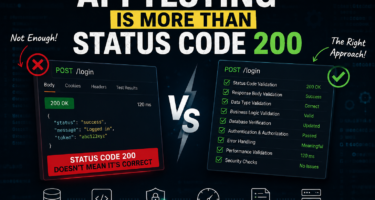
“Why are you validating Status Code 200?”
“Because AI generated it.”
“What if the API returns 200 but saves incorrect data?”
Silence.
“What if another customer’s data is returned?”
Silence.
“What if database update fails?”
Silence.
The tester had become an operator.
Not an investigator.
The Skill That’s Quietly Disappearing
Years ago, testers spent hours understanding requirements.
Drawing workflows.
Talking to business analysts.
Questioning developers.
Finding edge cases.
Today I see something different.
Requirement.
↓
Copy into AI.
↓
Generate test cases.
↓
Generate automation.
↓
Execute.
↓
Pass.
Very little thinking happens in between.
The scary part?
Everything looks productive.
Until production proves otherwise.
Case Study 3 – The AI That Didn’t Know the Business
A retail company migrated customer loyalty data.
AI generated SQL comparison scripts.
Everything matched.
Migration approved.
A month later, customers started complaining.
Their loyalty points had dropped.
Investigation found that points were rounded during migration.
AI validated numbers.
Nobody validated business rules.
That’s the difference.
AI understands data.
Experienced testers understand meaning.
Automation Is Getting Smarter
Ironically…
Automation has never been smarter.
With AI we can now generate:
- Complete frameworks
- API test suites
- Page Objects
- Mock data
- SQL validations
- Reports
- CI/CD pipelines
Amazing.
But here’s my concern.
If AI does all the building…
When will testers learn architecture?
If AI writes every SQL query…
When will testers learn databases?
If AI writes every automation script…
When will testers understand why it works?
Knowledge cannot be copied.
It has to be earned.
The Future Doesn’t Need Script Writers
Let’s be honest.
Five years from now…
Every company will have AI.
Every QA engineer will have AI.
Every developer will have AI.
Writing Selenium scripts won’t make you special.
Generating API automation won’t make you valuable.
Anyone can ask AI,
“Generate Playwright framework.”
The real question is,
“Will you know if it’s wrong?”
That’s where careers will be decided.
My New Rule for Every AI Output
Whenever AI gives me anything, I ask five questions.
- Why did AI generate this?
- What assumptions is it making?
- What is missing?
- What would a real customer do differently?
- How can this feature fail in production?
Those five questions have helped me find bugs that AI never suggested.
Because AI predicts.
Testers investigate.
Don’t Let AI Replace Your Curiosity
AI should reduce repetitive work.
Not independent thinking.
Use AI to save time.
Use that saved time to think deeper.
Talk to developers.
Challenge business rules.
Study production incidents.
Understand user behavior.
Ask uncomfortable questions.
That’s where great testing begins.
Final Thoughts
I’m excited about AI.
I use it every day.
It makes me faster.
It makes my automation better.
It helps me write code in minutes instead of hours.
But I never allow AI to replace the one skill that made me successful in the first place.
Curiosity.
The future doesn’t belong to testers who can write the most automation.
It belongs to testers who can think beyond what AI generates.
Because AI can generate answers.
Only great testers know which questions to ask.
And remember…
The biggest bug AI can introduce isn’t in your code.
It’s the moment you stop thinking because AI already did.

Leave a Reply